Tuesday, March 15, 2022
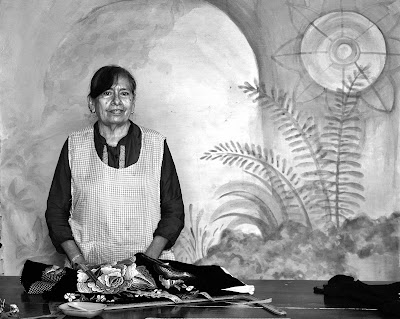
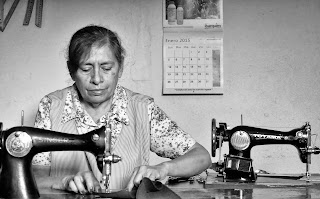
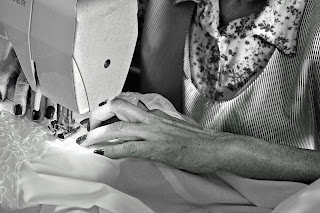
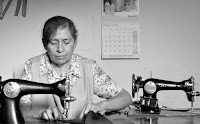
Elizabeth Gonzalez Gutierrez: Modista
Sunday, March 6, 2022
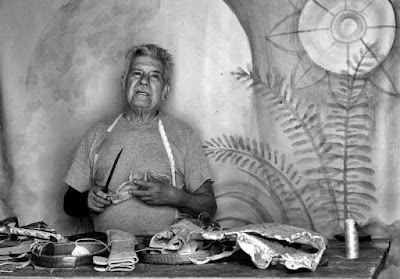
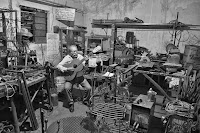
Luis Sarita: Talabartero
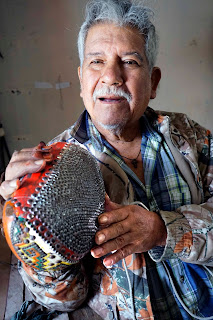
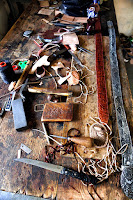
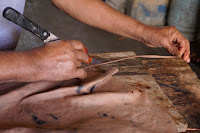
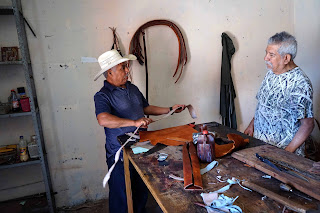
Luis Sarita is a leather worker (talabartero). He makes a range of products, from saddles, harnesses and holsters to billfolds, belts and huaraches. I met Luis in 2019. I was searching for a talabartero and a tanner (curtidor), and was told I could still find some in Ejutla, a pueblo an hour and a half from Oaxaca. It took a bit of searching, but I was finally directed to Luis's workshop. I explained my project to him and he accepted to be part of it without hesitation.
| Luis and his guante de Pelota Mixteca |
Wednesday, February 9, 2022
Carlos Ramiro Lopéz: The Last Scribe
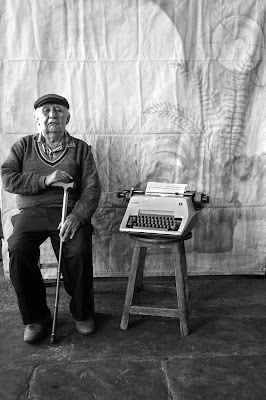
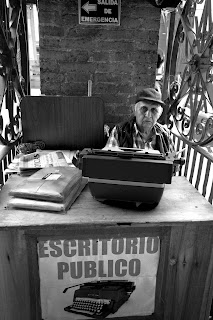
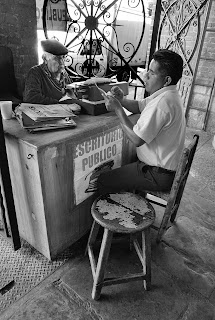
Carlos Ramiro Lopéz is a public scribe. For nearly sixty years he has been using his typewriter to help people express themselves through the written word. It is what has given meaning to his life and allowed him to eke out a meager living.
When I first saw Don Carlos in his booth in Oaxaca's Benito Juarez Market in 2015, I knew I had to photograph him. His oficio (occupation) was one that most certainly was on its way to extinction. When I asked his permission to photograph him and include him in my project I received and abrupt and unequivocal NO! It took me four more years to be granted that permission.
In the 1980s there was a demand for Don Carlos' work. There were politicians who came to him to type up official documents, migrants from the countryside who needed someone to pen a letter home to their families, and there were love letters to be written. Those times began to disappear with the advent of computers and were given a death blow by the arrival of the cell phone. People no longer had the same need for someone to help them compose and write their letters. Their phones had autocorrect and texting became the norm. The ritual of putting a letter in a stamped envelope and taking it to the post office was disappearing along with Carlos' profession. His work was now comprised more of typing bureaucratic forms in triplicate.
In March 2019 I carried my backdrop to Benito Juarez Market to do the portrait of Don Carlos. This time he was ready and willing for the photograph. We had had time to form a relationship and I think he knew, that at eighty, his days as a scribe were nearing an end. Shortly afterward the pandemic hit Oaxaca, I left for Oregon, and after I left, Don Carlos decided to close up shop and not risk what otherwise might be awaiting him. When I came back in January of 2022, He was longer in his booth in the market. A market vendor told me he was still alive but no longer came out much due to the virus. His small wrought iron booth was locked up and would not reopen. This is the first of the oficios in my project that I have witnessed die out. However, I fear that it will not be the last.
Friday, January 14, 2022
Oaxaca 2022: May They Rest in Peace/QEPD
| Dario Santos Paz |
| Liz at Work |
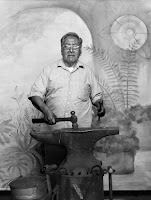
She saw me walking down the street and waved me over. After greeting each other and sharing our gratitude that we were both in good health, she went on to tell me that Dario, the blacksmith a half block down the street had passed. He was 80 and died of a heart attack. I had just finished writing his story right before I left Oregon. After leaving Liz I went straight to Dario's workshop to see his family. As I entered to see his daughter, I saw an altar set up for him with the last portrait that I had taken of him framed and in the center. I was very touched. She then told me that another blacksmith I had photographed a few blocks away, Jorge Diaz, had also died. Jorge's death was causwd by complications from diabetes. I am not sure if covid was involved. When I went to Jorge's shop on Xichotencatl to see his brother Moises, it was no longer there.
| Jorge Tocando |
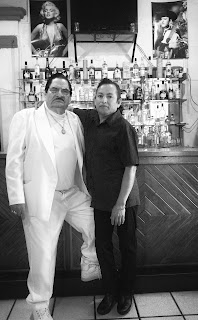
I was already aware that two other friends from the project had passed since I left, Manuel Garcia, silversmith, and El Pollo, Cantinero (tavern owner). Manuel died of covid at age 78 and Pollo of a hard living at the age 85.
Manuel preparing silver
| Pollo y Manuel |
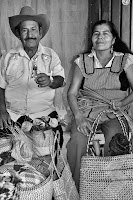
| Benita & Braulio |
Tonight I got in touch with the son of Israel Rojas, the sandal maker (huarachero) to find that he also has passed away this past November. HIs son, Ivan, told me that he died of natural causes at the age of 86. He was pleased to say that Israel was conscious and alert until the final moment.
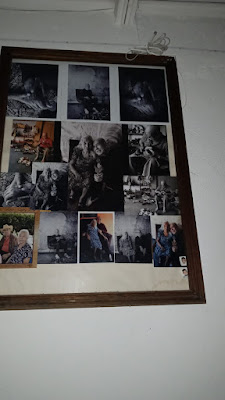
I am deeply saddened by the departure of these friends. Over the past few years we have opened our lives to each other. We have formed bonds of friendship that are unique in many ways. When I communicated with Israel's son, Ivan, tonight he sent me a picture of a photo collage they had hanging in their home. It brought tears to my eyes to see the photos I had given them in such a place of honor. It makes me very happy to know that people value these photos as much as I value these people.
I also found out tonight that another friend from the project had died, Luis Sarita, talabatero (leahter artisan). Luis died from a blood disorder. He was an avid fan and player of Pelota Mixteca. His friend, Alberto Pacheco informed me that they carried his coffin to the playing field and gave him a final send off in the manner he would have appreciated.
The wheel of life and its culminating act, death, never stop. I am honored to have known these fine people. They have made my life much fuller.
Monday, February 15, 2021
Teodoro Bautista Perez: The Earth Beneath his Feet
Teodoro Bautista Perez is a campesino in the most traditional sense of the word. He started to work the land under the guidance of his grandparents in the sixties when he was ten years old. They had learned from their grandparents and the traditions of working the land were passed on from generation to generation with much pride and respect. At age sixty-eight, Teodoro has changed the way of working the land very little since his childhood. He has his junta de toros (team of oxen) and besides planting his own fields, he contracts out to plow the fields of others in Capulalpam de Méndez. Since the countryside is very hilly and the steep slopes make it dangerous to plow with a tractor, the junta is the only way to go. The animals do not damage the earth as much as the heavy tractors that tear up the hillsides and open them up to erosion. Teodoro still makes the wooden ploughs and yokes for his junta. It is part of the tradition passed down from his grandparents. It is about being self-sufficient.
Teodoro reminisced of the days when ninety percent of the families in Capulalpam grew their own food and worked the land with their own junta. Now he claims, there may be thirty percent who farm the land and there are only three teams of oxen left to do the plowing. Despite the seeming timelessness of Capulalpam, some things have changed. "In the old days there was plenty to eat: corn, beans, wheat, animals that we raised. But we had little money to buy clothes and shoes and other things that we needed. People worked hard and we got by. Nowadays people have become flojo (lazy). Farming is hard work. Es muy duro, pesado. People are abandoning working the land”.
Fewer and fewer of the youth in the pueblo are interested in farming. Now that there is a secondary school in Capulalpam, young people have other options for earning a living. Those who can afford it go the university in the city of Oaxaca an hour and a half away. Many do not come back as it is easier to find good jobs in the capital then in the pueblo. Some of those who remain go into farming, but the majority seek less demanding jobs that pay more for easier work.
Teodoro told me that a team of oxen costs about 40,000 pesos ($2000 US), a lot of money for a farmer in Mexico. First you have to train them, which is not an easy task. It takes about a year to train a team, and if you pay someone else to do it, that is another 20,000 pesos. So Teodoro trains them himself. A team lasts three to four years. "Once a team is trained they can do the work by themselves", he explained. "You have to handle the plough but they know where to go, when to stop, when to turn around". But it is hard work to get them to that point. Oxen are enormous creatures and do not like having a yolk put on them so they can pull a heavy plough through the hardened earth. You need to know how to handle them or you can get hurt badly.
I wanted to get a portrait of Teodoro with my backdrop and he proposed doing it out in his field where his plough and yoke were. We jumped in his pickup and drove the mile or so to where his terreno was. The landscape is very steep and hilly and the soil broken up and hard to walk on. I dragged my backdrop down a steep hill and Teodoro went and got his yoke and his plough. This is where he wanted to have his portrait taken. This is where he belongs, with his head held high and the earth beneath his feet.
Monday, February 1, 2021
Israel Rojas Rojas: Huarachero with a Heart
I had been looking for a huarachero (sandalmaker) for some time before I was directed to the home of Israel Rojas Rojas in the barrio de la Merced in Oaxaca Centro. I was looking for someone who was a maestro (master artisan), but there were fewer and fewer to be found. There was no sign announcing his workshop and I had to ask around the neighborhood quite a bit before I found a door to knock on. When I did, a young man opened the door and informed that indeed this was the home of a huarachero, but that he had stopped working a couple of months earlier due to age. We talked for a while and he invited me and called his father, Israel.
![]() |
| Israel Rojas |
When I explained what I was doing, Israel perked up and became excited that I was interested in his life work. We talked for quite a while and he proposed to work for a while so that I could photograph him. I gladly accepted. His grandson, Ivan, had taken over most of the work when his grandfather decided to step back. But Israel was proud of the what he had done with his life. He started working as an apprentice when he was eleven. He learned by doing, and at eighty-eight, he had become a master. He had taken on several young people as helpers who could learn the trade, but none had the commitment and determination to stay with it to the end. When I asked Israel why, he told me that “ser huarachero es una vida muy triste, muy pobre” (it is a very sad and poor life). He also said that the hides used to make the huaraches often had a very unpleasant odor. It was enough to drive many away from the trade. The materials had also gotten very expensive and if you hired an assistant to help in production, your profit was nearly gone. Israel sadly believes that his is a dying occupation. It is not what it once was when there were hundreds of huaracheros in Oaxaca.
Israel managed to earn a fair living as a huarachero because he was able to work fast and not sacrifice quality in doing so. At his peak, Israel’s son and daughter worked with him and he took his product to Mexico City to sell. At one point in the 1960s, Israel could earn 250 pesos in Mexico City compared with 8 pesos in Oaxaca. Huaraches were very popular and many were being exported to the States as they were in vogue. But when the demand dropped off, so did the sales. Selling in the markets also meant that others could steal your designs; and they did. It is a hard way to earn a living.At eighty-eight, Israel no longer has the strength in his arms to work the leather as he once did. His grandson, Ivan, has taken over and makes a meager living doing so only because he does the making and the selling by himself without hiring help.
![]() |
| Ivan Rojas at work |
Israel’s huaraches are high quality and well made. But what impressed me perhaps more than his leatherwork was his love of life and his joyful love for his wife, who he calls his pollita (little chick). When she came out in the courtyard once we were done photographing, his eyes lit up and a huge smile spread across his face. I offered to do a portrait of the two of them and he was thrilled. There was no question that she was the love of his life. And it was obvious that she felt the same way. If Israel put as much love into making a pair of huaraches as he does in caring for his wife, no wonder he did such superb work!
![]() |
| Los Enamorados at 88 & 91 |
Monday, November 30, 2020
Man and the Machine: Gabriel López Artigas
I love working on a typewriter - the rhythm, the sound. It is like playing the piano, which I do too. David Mamet: Playwright
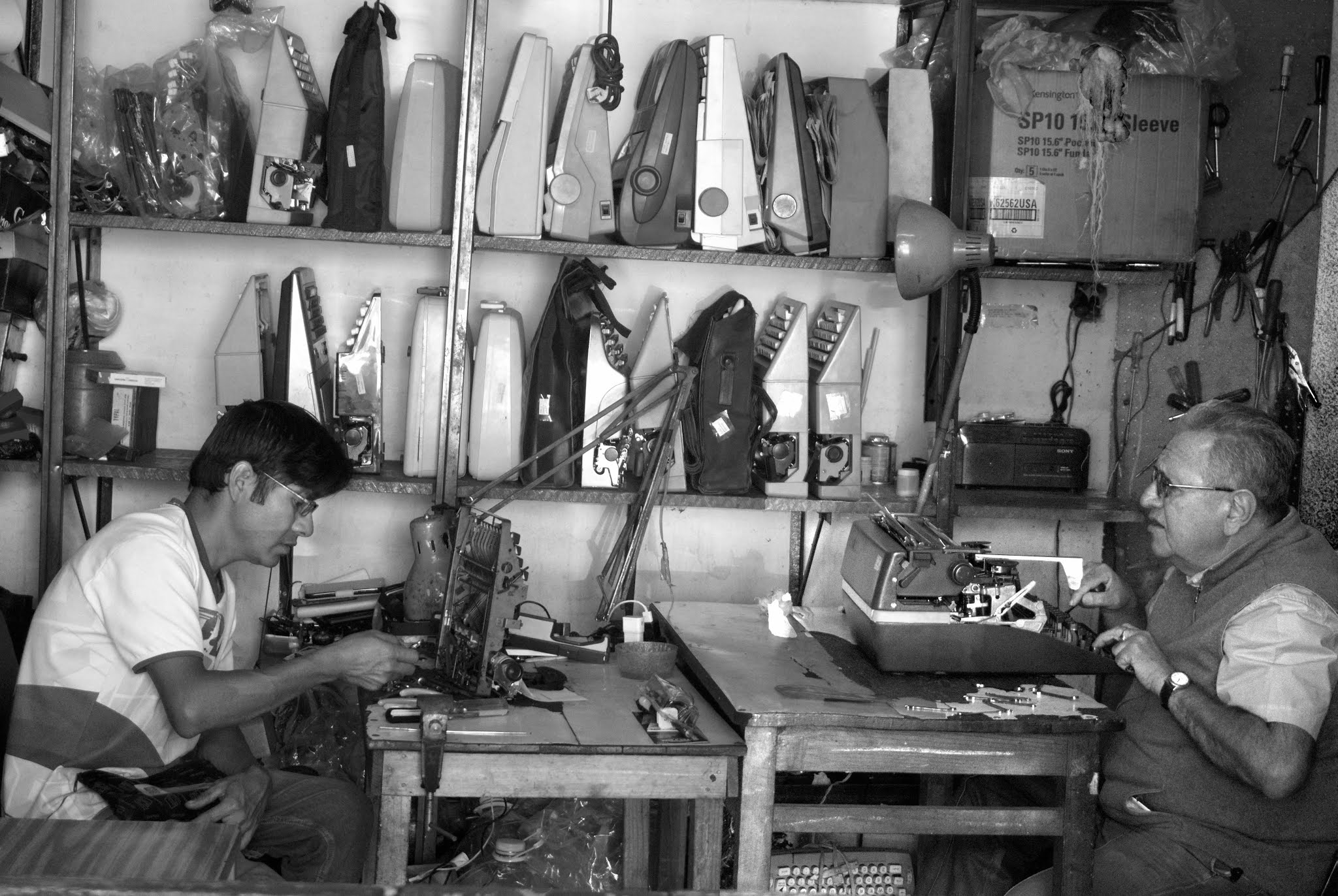
I had walked past Gabriel's Oficentro shop in Oaxaca many times before curiosity got the best of me and I stopped. It was a tiny space filled with old manual typewriters. Gabriel was seated at the front counter fixing something. He is a "fixer" by trade, with manual typewriters being one of his specialities. My Oficios project (occupations) is focused on jobs in Oaxaca that are in danger of dying out. I have photographed and interviewed many craftspeople and artisans as part of my project and all were practicing a profession that was a part of Oaxaca's traditional culture. I had not approached Gabriel earlier as I did not see his job as falling under the category of "traditional". But I could not help wondering: "how can a person earn a livelihood repairing and renovating old manual typewriters"? So I stopped to find out.Gabriel has been at his location on Fiallo in the Centro Historico of Oaxaca for over thirty-seven years. In 1986 he found himself without work and joined his father-in-law in his small machine repair shop. He started doing the paperwork and clerical work and ended up doing what he liked best: repairing machines. After one year, he started his own shop with a friend who was unemployed at the time. He has been repairing typewriters, calculators and other small technological devices ever since. Most of them are typewriters, Hermes, Olivetti, Smith Corona to name a few that line his "to be repaired" shelves. "There used to be over forty shops like mine in Oaxaca, but the arrival of the computer drove most people out of business. Now if there are three shops like mine, that is a lot". He has one young employee, Javier, who has learned the trade well. Gabriel told me that on an average week, he receives about thirty typewriters to repair. What he likes best about his work is seeing peoples reactions when they come back to get the old, beat up typewriter they had brought in. It looks like new and it works perfectly! He still has lots of people passing by stop to tell him that the old typewriter that he repaired for them many years ago was still working perfectly. All of his repairs come with a one year warranty and the electric ones get one year free maintenance as well!
There is no question that modern technology has put a serious dent in his business. But there are still the chosen few who love their typewriters and will never give them up. Gabriel said he felt his role had become one of preserving antiquity, keeping old ways alive. However, at age sixty-four, he has no one in his family interested in taking over his business when he retires. Like so many that I have interviewed, the chances of his business surviving when he is gone are slim. He is a dying bred.
Since Gabriel's shop is only three blocks away from my apartment in Oaxaca, I stopped by often to say hello. We became friends. He still communicates with me while I am here in Oregon, He does not send a crisply typed letter by mail, but rather texts me on WhatsApp using his cell phone. I have no doubt that if that goes on the blink, he can repair that too. That is what "fixers" do.