Monday, June 29, 2015

A Symphony of Looms

José Leyva Garcia: Artisano Textil (Mantelero)

 I interviewed Don Chepe and his son, Gustavo in their workshop in el barrio Xochimilco, in the Centro Historico of Oaxaca. Gustavo did most of the talking as Don Chepe was busy spinning spools of cotton thread for weaving the various linen products that they specialized in. One hand spun the wheel, while the other held the "canilla"(reel) receiving the thread. He does this every day of the week from 8 AM until 7 PM, with a lunch/siesta break fit in somewhere in between. He can no longer physically do the weaving he did for most of his life, but his canilla keeps him very busy. He still loves his work.
La canilla
Don Chepe has been weaving for over seventy years. He began when he was sixteen, learning from his father, who had learned from his father. Four generations of the Leyva Garcia family have been working in this same taller (workshop) and producing quality linen bedspreads, tableclothes, curtains, etc. that they sell directly from their home workshop. When I asked Don Chepe what he likes most about his work, he answered, "Todo, desde principio al fin. Nunca pensé hacer otra cosa" (Everything, from beginning to end. I never considered doing anything different).
Don Chepe had nine children, six sons and three daughters. Four of his sons still work with him. They hold other jobs as well, but their true calling is at the loom. This is work of the heart, something they do as a family.
Pancho, Javier, Gustavo & Mario working together


Their workshop is on the corner of one of Xochimilco's colonial streets. It is inviting, and many people stop to watch and are invited in. Some buy a bedspread or curtains. All are treated like honored guests. The family is proud to show their talents as weavers to whoever may stop by. That is how friends and sales are made.
Gustavo told me that people were tired of seeing massed produced products that were all alike. They liked the traditions of Oaxaca and the fine craftsmanship of its artesania. "El artisano no tiene que buscar el mercado, el mercado viene al artisano" (The artisan doesn't have to seek out a market, the market seeks out the artisan).

Gustavo showing the tools of his trade

As true as that may be, to make it only on weaving is very difficult. The economic situation in Mexico makes living as an artisan a risky business. All, except for Don Chepe, had worked a second job at some point for the steady income. The job filled "la panza" (your belly) Gustavo told me, but weaving filled the body, the soul and the spirit.
In the sixties and seventies, almost every house in Xochimilco had a loom. The click clack of working looms resonated through the streets."When I was a child, it was a marvel to walk into this barrio", Gustavo told me."There was a symphony every day. It was padrísimo (awesome)! "It was so common, that I don't think people realized what a symphony it was, ... like the birds singing in the church courtyard at dusk".
Today it is more like a chamber recital with all four brothers playing. They are what remains of a livelihood that was once in every household of Xochimilco.
When I asked Don Chepe if he ever thought of retiring. He laughed and told me, "Mi pensión es mi bobina" (my retirement is my spinning spool). It gives meaning to his life.
Mario at his loom

I visited the family four or five times and  purchased a bedspread and curtains from them. We had become friends. When it was time for me to leave, Gustavo commented, "this photography project you are doing is letting you see the real Mexico, the 80% of us who do not live like the 20% that the media portrays as "normal life" in Mexico. The wealthy have their reality, and we, the people, have our own. When you buy something from us, you take with you a part of our lives, la parte humana de la artesania (the human aspect of artesania)". And that is what makes all the difference.

Saturday, February 28, 2015

Working with Dignity: A Oaxaca Portrait - Part One

Don José: Blacksmith
Recently Colectiv-O,the photography collective to which I belong, initiated a photo project entitled "Oficios" (occupations) for World Art Day 2015. Our project is to choose occupations that are very old or in danger of dying out, and print them poster size to be plastered on walls in the Centro Historico of the city. Since I had already begun working on a project very similar to this, I was happy to participate. One of my shortcomings as a photographer is my fear of approaching people and asking permission to take their portraits. This project gave me the perfect point of entry; it recognizes the importance of the work that these people do, and it serves as good publicity for them as artisans.
Bonifacio: Organ Grinder

I was very touched by the openness of the people that I chose to photograph. Much like Marie's sketches, my session with them opened a channel for dialogue, for sharing personal feelings about their work, and their lives. It made me think of Stud Terkel's book,Working: People Talk About What They Do all Day and How They Feel About What They Do. (1974). So I ordered it  for my Kindle (immediate gratification). But what I found soon into rereading it, was that most of Terkel's participants did not like the work they did. Few felt truly satisfied and many felt alienated by the work they did. What I was discovering was to the contrary. My neighbors here in Oaxaca were proud of what they did! They were a dying breed in many instances, but they recognized the value of their work and the skill involved in doing it. It gave me an idea for a book about these people and their feelings about their "oficio". It appears I am much better at starting books than finishing them! So this entry is a sampler, the embryonic stage of what someday might bring Studs Terkel out of his grave: Working with Dignity: A Oaxaca Portrait.

Bonifacio is an organ grinder, an occupation that is held in high esteem in Mexico. The occupation goes back to the end of the 19th century when the German government sent a gift to Porfirio Diaz. It is hard work, as the organs are heavy and must be carried from place to place to perform. Organs are not easy to find anymore and outside of DF, there are not many grinders to be found. It is a disappearing profession. Bonifacio got his from some artisans that were closing up shop. It is an old organ, simple but solid. He plays on markets days throughout the city. He is from the Mixteca, a mountainous area outside of Oaxaca, and has a wife and five children. He also makes wooden toys that he sells sometimes in the market, and his daughter Marisol sells gardenias along side of him.The day I photographed him, I bought two bunches from her for Marie's altar. I hope they were not too fragrant for her! Today I went to the Merced market and gave him copies of some of the photos I took. He was thrilled, and so was I. 
Pepe & his Monos de Calenda


Pepe is the subject of yet another book project, one that I started soon after arriving in Oaxaca this fall. We met last year at a festival and we had a strong connection. Pepe used to repair tires, even came to your house to do it. But that business went under, so now making the monos, giant paper-mache puppets, is his only livelihood. He rents them out and sells them as well. Monos are big in Oaxaca, almost every wedding, church festival, and community event is not considered a "true event" without the monos, the "banda municipal", and dancing. Pepe is a social butterfly, a fixture in his neighborhood where nearly everyone that passes by stops to have a few words with him. If they don't stop, he talks to them anyway, especially the women. But he does so in a respectful, comical way that draws a look back at him and a smile. He never knew who his father was, and when he asked his mother, she told him "Pedro Infante", one of Mexico's most renowned actors. He took it to heart. You can see Pedro looking over his right shoulder in this photo and Pedro's photo is on Pepe's altar alongside of his recently deceased mother.

Don José is one of two blacksmiths that I visited. His workshop is in his home, a humble space where he spends most of his day. It is full of pieces of iron, wrought iron furniture, and tools of all sorts. When I returned at night to give him a copy of his photo, he was playing guitar to relax from the day's work. 
He takes great pride in the detail work he does, the difficult bending and shaping of hot iron. He has been working iron for over forty years, and he makes it look so easy. His eyes sparkle like the charcoals that heat his iron rods as he pounds them into shape. There is no one learning his trade from him, no one to pick up his hammer and man his anvil when he is gone. "It is too much work, takes too much patience for the young people today", he tells me. So he continues to do the work he loves as if he will do it forever. After all, there is no reason to stop doing what you truly love to do. Bonifacio, Pepe and José take pride in the work they do. They may struggle financially to make ends meet, but then, most artist do.Their art form brings meaning  and satisfaction to their lives. It puts bread on their table, gives them a much deserved sense of self worth, and allows them to hold their heads high.That is what work should do for people. (More stories and photos to follow).

Friday, January 9, 2015

The Power of the Pencil

Four years ago today (January 9th) Marie left on her ultimate sketch journey. Even in those last days, when she was too weak to lift her pencils, she continued to sketch with her eyes. Her pencils were her passion, her avenue to make sense of this world. 


At the time of this writing, the nightmarish events of the Charlie Hebdo massacre in Paris still continue, with more innocent people being killed in the name of religion. My friend, Carmel, sent me the image to the right from France this morning, commenting how much Marie would have been in agreement.The power of the pen(cil) cannot be silenced.


Teotitlán del Valle
Marie's pencil brought people together. Wherever she stopped to sketch, people were attracted to see what she was doing, what she was capturing on paper. And very often friendships blossomed because of it. Her pencil lines crossed cultures and celebrated the differences and similarities between us all.
Purepecha woman, Michoacán

A couple of years ago, my friend Greg took a photo of the altar I have for Marie in our bedroom. I wrote the poem below to accompany his photograph. Happy sketching Marie!! May your lines continue to cross borders and realms, and bring people together in harmony.
Greg's photo

Below is a link to a slideshow I have posted on Youtube and on my Facebook page. It is 7 1/2 minutes in length. A bit long, but then Marie deserves it!


A Sketch from the Other Side

From her altar in our bedroom

she smiles at me with pen in hand,

sketching with her eyes

what her hand no longer can.

The glazed Oaxaca-toned urn

that holds her coarse gray ashes,

can no longer contain her.

She descends at will

the narrow black ladders

that adorn the sides of the urn,

a portal from another realm traversing

the void between life and death.

New pages sketched in thin air

capture the moment as viewed
from the “other side.”

Saturday, December 6, 2014

No Matter Which Way You Look

Demonstration in the zocalo of Oaxaca
For most of my life, I have been a firm believer in evolution. It seemed logical that as the millenniums passed, (wo)mankind would progress in a manner that would lead to a more peaceful and harmonious existence. I never expected that we would arrive at a perfect world, but I figured we would be able to look back and say, "Wow! Glad we have gotten our act together some since those days". The state of the world today has me seriously wondering if we have, if we really have learned anything from our numerous mistakes on this planet.
At first I thought that perhaps I was mistaken about what evolution was supposed to be, so I looked in up the Merriam Webster online dictionary:
1) :  a process of continuous change from a lower, simpler, or worse to a higher, more complex, or better state :  growth (2) :  a process of gradual and relatively peaceful social, political, and economic advance.This did not seem to be what was taking place in Mexico.The disappearance of the forty-three students from Ayotzinapa, Guerrero, has thrown Mexico into a state of rage and unrest. There has been sustained outrage the likes of which have not been seen
in Mexico for many, many years. Not a day goes by without a front page story about the situation here. And as the communities continue to look for real evidence concerning the disappearance of their loved ones, more graves are found and DNA analysis confirm the remains are not those of any of the forty-three students! Who are they then? How many more are there?
The demonstrations grow and the government crackdown on them becomes stronger.
Zocalo in Oaxaca
Street art
Today's headlines of La Jornada show a 18 year old youth in Chiapas lighting himself on fire in front to the government building to demand the freedom of his uncle, a campesino leader held since last May on trumped up charges. Popular protest art is again filling the streets and zocalo of Oaxaca. Roadblocks are an everyday occurrence here, and it polarizes the community at times. Frustration and a sense of total mistrust of the government fill the air.


Roadblock on one of Oaxaca's main streets
But no matter which way you look, north, south, east, or west, it seems to be the same, injustice abounds. As the banner on the bus reads: If there is no justice for the pueblo, there will be no peace for the government. I have no photos of Ferguson or Michael Brown. Nor of New York City and Eric Garner. They are not necessary, your eyes have seen it all. And it appears that people everywhere have had enough, ¡Basta! Maybe this is evolution in process, if it can stay peaceful and focused on meaningful change. There are indeed signs of that here and in the US. Tomorrow there is a gathering and concert calling for justice and solidarity with Ayotzinapa.
And later this month there is another gathering of hope on the coast of Oaxaca calling for the defense and autonomy of territory.

So as people in Mexico and Ferguson, and New York fill the streets to call for justice, let's hope that someone listens. And may some of those who listen be those in power who can decide that indeed "enough is enough!", and take action to bring about real change. Then I can go back to believing in evolution, in believing that when my time comes to leave this earth, I will feel that we are a kinder and juster species than when I first set foot here.

Wednesday, November 19, 2014

Mud, Manos, and Corazón

Living in Mexico often gives me the chance to enjoy the simpler things in life. En "el Norte", it is easy to get caught up in first world comforts, often mistaking them for progress. I remember receiving a book entitled Handmade Houses as a gift one Christmas. Wonderful dreamers they were! And I was pleasantly surprised to see that those dreamers still exist and are building their homes in Mexico as they have for centuries.

Don Marciano's kitchen
Recently I was contacted by my friend, Angeles, who invited me to accompany her and four of her students on a trip into la Sierra Sur de Oaxaca. Angeles teaches architecture at La UNAM (Universidad Autónimo de Mexico). She is heading up a project to preserve traditional building techniques: mud, stone, and adobe, by finding and interviewing people who still know the secrets of building with the earth.

Our first stop was in San Tomás, a small pueblito in the region of Miahuatlán. We had no arranged visits, but Alicia, a natural builder familiar with working in the comunidades, soon lead us to a stone and mud house and struck up a conversation with the owner and builder, Don Felipe. Before we knew it, Don Felipe was showing us around and sharing his knowledge of natural building with pride.
The house Felipe built
All of the materials for his house came from his land: stone, timber, and earth. I was curious about the mud, which was white, not brown. He knew his land well. He took us to the place where he got the earth near his spring. He added some water until it was just the right consistency to stick together solidly. It took Don Felipe two years to build his house, but like many of the other houses in the area, it will stand for many, many more.
Doña Lorenza Agustina
One of the highlights of the visit was meeting his 84 year old aunt, Lorenza Agustina. She has not been able to walk for over fifteen years, yet she was a bright light in her somber earthen kitchen, upbeat and full of positive energy. Like the walls that surrounded her, she has settled firmly into place.
Don Felipe con su barro
Felipe then gave us directions to the house of Don Marciano, one of the elders of the area who was a master builder. After a good while of roaming the bumpy dirt roads, we found the house. Don Marciano is 87. His daughter told us that his memory was not what it used to be, that he might not be able to remember much of his earlier days. But what he had done all of his life was well engraved into his faltering memory; he did not hesitate in recalling how to transform earth to home.
Don Marciano
La esposa de Don Marciano
We were treated like royalty by the family. Marciano and his wife had ten children, nine daughters and one son. They were there para servirle (to be of service). They gave us a tour of the farm, answered any questions that we had, and then invited us into the kitchen to serve us pan y chocolate a la oaxaqueño. Nothing better!

Nestora, one of the nine daughters


We made two more stops before I returned to Oaxaca. We spent the night in El Refugio in San José del Pacifico, where an intentional community had built their homes of mud and adobe, very beautiful structures. 
Again, all the materials came from the land where the houses were built. Although there were monetary costs involved in the building, they were minimal comparatively speaking. The greatest cost was undoubtedly in time and human labor.
These homes were built with mud, hands and heart, and one feels it immediately upon entering.The earthen walls seem to be smiling as they welcome you. It makes you feel as if you have become one with the earth, as if this is where you belong. Home is where the heart is, as the old adage goes. Add some well mixed clay and hands that are not afraid of hard work, and you have yourself a home that is in perfect harmony with nature and that nourishes the soul. May the knowledge and techniques needed to create such a space never be forgotten. Thank you Angeles for doing your part to make sure that never happens.
El Refugio, San José del Pacifico

Wednesday, November 5, 2014

The Grateful Dead: Part Two

El Panteón de Xoxocotlan, Oaxaca
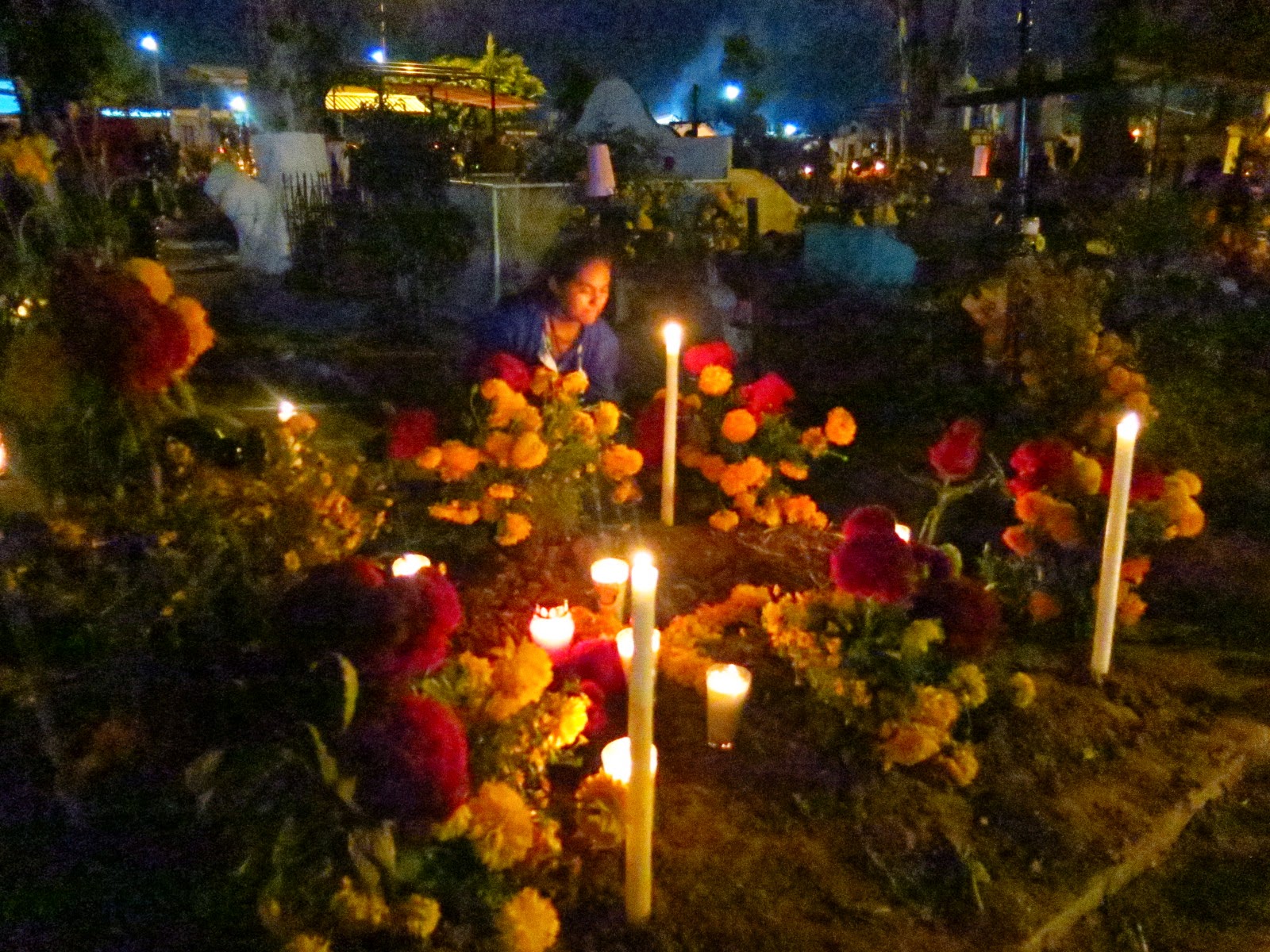
The night of October 31st was the night in Xoxocotlan to illuminate the tombs of loved ones. The cemetery was aflame with candles of all sizes, and families camped out for the night around the tombs of family members who had passed on. There were tombs of all types, some rather elaborate
and others nothing more than a mound of piled up dirt for the many who could afford nothing more. They were equally beautiful and touching. I was invited to Xoxo with the owners of my apartment, Hector and Lulú. We arrived shortly after dusk and found the cemetery already aglow and many families already installed to pass the night with their loved ones. Despite the chilly weather, there was a feeling of warmth that permeated the cemetery. Marigolds and Cockscombs were everywhere, illuminated by candles of all sizes. I felt as if I had passed through a thin veil that separated reality from otherworldliness, not sure which was which! It was truly magical.


At one end of the cemetery was an enormous stage set up for the concert by Juan Casaos, a popular Mixteca singer, and La Banda Sinfónica Juventil of his pueblo in la Mixteca, a mountainous region of Oaxaca.There were monos de calenda, giant paper maché puppets, spinning around the stage and young people performing danza folklórico to the traditional Oaxqueña music. There was no doubt that "los muertos" were having a wonderful time, going back to their tomb for a shot of mezcal and then back to the concert to join the festivities! Just goes to show that there are advantages to being dead!


Magos hererra
The evening of November first there was a special concert by Magos Hererra, a Mexican jazz vocalist now living in New York. She just happens to be one of my favorite performers! I thought I had died and gone to heaven!! Magos and her group performed outside on a very chilly Oaxaca evening to a full house. She encouraged us to applaud to keep warm, and we did.
She  herself wore a pancho given to her by Chavela Vargas, one of Mexico's most revered musical divas, who passed away in 2012. This concert was a special offering to Chavela. Magos was accompanied by a very talented group of musicians from DF (Distrito Federal). A superb performance despite the cold that kept the string players rubbing their strings to keep them tuned properly.
How was I able to get photos so close up? No security thugs guarding the stage, no check for concealed weapons at the concert site. Just a lot of good people celebrating Día de los Muertos and enjoying the incredible cultural richness of Oaxaca.


Santo Domingo
After the concert I walked to La Iglesia de Santo Domingo, a few hundred meters away. I arrived just in time for a light show projected on the facade of the church. Apparently the concert was not enough! ¡Qué chido!

My altar for Marie, minus the mezcal glass which I drank!
I went home at midnight, sensually saturated, poured myself a shot of mezcal, and one for Marie, and went to bed. I was literally "Dead tired"!


Monday, November 3, 2014

The Grateful Dead: Part One


In remembrance of the 43 students that disappeared in Guererro
Día de los Muertos has come to an end, and besides the scores of roaming spirits who have decided to stay on this side and celebrate for a while longer, things are going back to normal. What a different way of looking at death! There is normally an “alegria” in the air, and instead of sadness and melancholy dominating the scene, there is celebration and fond remembrance of loved ones passed on. This is still the case, however Día de los Muertos 2014 is also shrouded in sadness and outrage. The disappearance and probable death of forty three young students in Ayotzinapa, Guererro in late September, has placed the spotlight on deaths that never should have happened. http://www.newyorker.com/news/news-desk/crisis-mexico-forty-three-missing-students-spark-revolution
Plaza de la Danza, La Soledad
Many of the typical decorations of ofrendas and tapetes (sand paintings) have focused on this tragic event. Since September 25th, there has been no sign of the students, no bodies identified, although they have discovered mass graves, and remains are awaiting DNA testing. In the meantime, the well respected daily newspaper, La Jornada, has reported that government official have offered families of the missing students one hundred thousand pesos each for their silence. A national student strike has been called for November 5th in all parts of Mexico. Mexicans are fed up with the deaths of innocent people caused by cartels and corrupt government officials. Unrest fills the air.

But the resilient spirit of los Mexicanos shines through, despite the cloud above them. Families still make the traditional mole to share with visitors on November 2nd, the last day of the celebration. Although mole can be purchased in the market ready to use, many families still prefer to prepare it themselves, a complicated and time-consuming process.  There are four types of chiles to be toasted over a charcoal fire. There are plantains, almonds, prunes, raisins, peanuts or walnuts, cinnamon, clove, sesame seeds, onions, tomatoes, oregano, and a special bread for mole to be added ingredient by ingredient.
Doña Soledad's mole
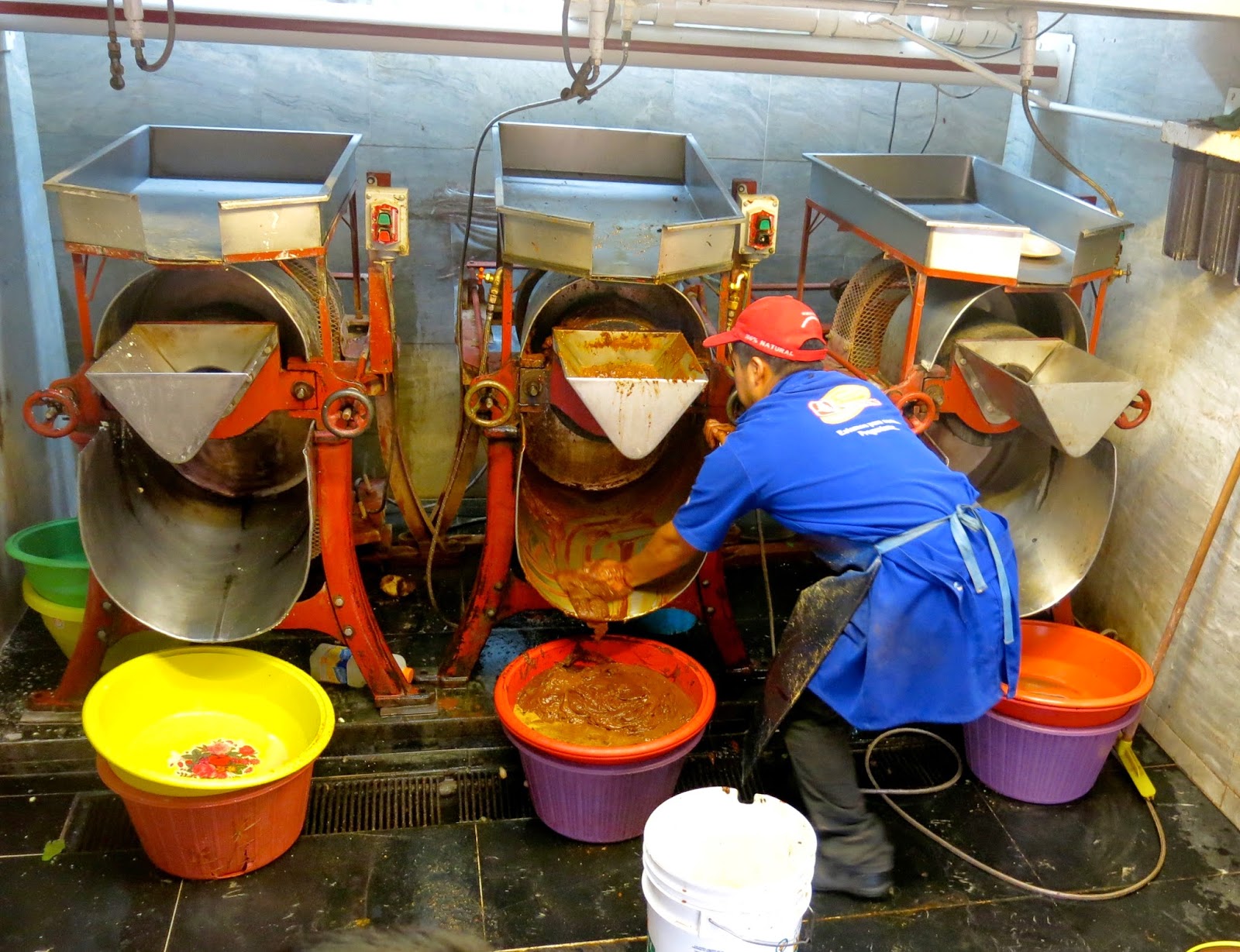
Once everything is toasted and mixed together, it is brought to the local mill to be ground. Doña Soledad took hers to the Mayordomo Chocolate mill a half kilometer away from our house.  Weaving through traffic with her hand truck was risky business, but she got there in one piece and did not lose one drop of mole!
Al molino
Then back home with the ground ingredients to cook it for a few more hours, stirring constantly, bien seguro, to avoid burning. It is a full day of preparation, morning til night.
Yesterday I had the pleasure of sharing her mole with family members and friends. It was well worth every minute of toasting, grinding, and stirring! ¡Muy, muy sabroso!

On the way to the molino to grind the mole ingredients, were stall after stall of flower vendors selling marigolds (cempasúchil), cockscomb (Terciopelo), and a variety of other flowers to adorn the altars and tombs of loved ones. There were truckloads of  flowers along the busy streets, and nearly everyone you saw had a bouquet or two in their arms. And next to the flower vendors were those selling copal, a mineral burned as incense on the ofrendas.
Copal vendor with customer
The altars and ofrendas deserve a whole blog to themselves. But since long blogs are hard to read, let it suffice here to give you a sample or two.


I always wondered where the name Grateful Dead came from; now I think I know. Who wouldn't be grateful for the abundance of all the things you liked while you were alive: food, flowers, drink, tobacco and music?


The figure below holds a banner that reads:"Death says, with me there are no bribes". Perhaps the government official who ordered the massacre of the students in Ayotzinapa should take these words into account!
Parade of Barrio de la Noria, where I live