Sunday, November 24, 2013

All Things Fall in Place


Huichol depiction of Life after Death
I hate departures, leaving people you care a lot for and at times wondering why you are leaving. I have done it enough times, however,  to believe that "vale la pena", that sometimes what you are feeling is growing pains, that what will come out of your experience will be worth it all. There is something very strong in Mexico that calls me. I like to think that in a past life I sculpted giant Olmec heads from massive stones in Tabasco, or rode the wind with Emiliano Zapata to save "La Patria". It feels like home .


Free Beer Tomorrow!
I arrived in DF at 5:37 am on Friday, November 15th. My friends, Sergio and Emma, had offered to let me stay in their apartment in San Angel for a few days to explore Mexico City, something that I have never really done. But between the red-eye flight with very little sleep and a chilly late November morning, "Kaboom", I fell prey to an authentic Mexican "catarro" (head cold) that put me out of commission before I began. But I pushed my better judgement aside and decided to explore anyway. It is hard not to succumb to the seductive calls of fresh fruit and jugo stands, Saturday craft markets in the plaza, and sidewalk cafes where a few ice cold Negra Modelos seemed to be the best medicine I could possibly find. 
I met my friend, Angeles, for lunch and, besides the ice cold Negra Modelos, I indulged in a lunch buffet of an "all you can eat" seafood spread that only the Mexicans can prepare. Chile rellenos stuffed with fresh tuna, shrimp sauteed in garlic, squid empanadas,Caramba! I hardly knew I was sick.
Jazz Players near the Zocolo
Sergio arrived from his home in Puebla the next morning to show me around. He took me to visit El Templo Mayor, an incredible museum built on the site of the ancient Aztec city of Tenochtitlan. Most of what was in the museum came from directly under the site, which is a block from the zocolo in the heart of DF! We surfed the pedestrian walkways from La Alameda to the Zocalo, caught in a wave of humanity out for a Saturday walk. There was movement and entertainment everywhere. I had hoped that the scorching midday sun,  massive quantities of chile de arból hot sauce, and ice cold Negra Modelos that I had consumed would knock my "catarro" right out of me, but no such luck. I went back to Puebla to Sergio and Emma's house with a very red nose and pockets bulging with saturated Kleenex.

Glass blower making Christmas ornaments
 The next day I boarded an ADO bus bound for Oaxaca. The bus had comfortable reclining seats with lots of leg room, drop down television screens that were showing episodes of Starsky and Hutch, and two bathrooms, one for men and one for women, a very desirable thing to have. If you have ever tried to pee in a moving bus on curvy, bumpy roads, you will know what I mean.

 I close this entry from my new apartment on Calle Pino Suarez in el Centro Historico de Oaxaca. The sky is cloudless, and the silence of Sunday morning fills the air. Time for a walk to the Zocolo for a glass of freshly squeezed orange juice or a fruit salad of papaya, piña, grapefruit, and mandarina to start the day. 

Perhaps I am just lucky, or perhaps it is my ancient ancestors here that are glad that I am back, but whenever I arrive in Mexico, I am amazed at how effortlessly all things fall in place.

Saturday, September 14, 2013

Altiplano Encounters


La Hacienda on the Road to Muñoz
Marie never tired of stopping to sketch the landscape of the high desert surrounding us. It was often on bicycle to Muñoz, a nearby pueblo, to check our e-mails at the butcher shop/internet café that the scene was most striking. I would often be in front, pedaling hard on the uphill slope in hopes of beating the mid morning heat. When I looked back, I would see Marie straddling her bicycle, sketchbook in hand, capturing the moment.
There were two roads leading to Muñoz, a little traveled, bumpy, dirt camino that was scenic and peaceful, unless, that is, a bull had gotten out of the corralled area that ran the length of the camino to Muñoz. It happened more than once. Several locals had warned us that if we encountered one bull in the road between our destination and us, we best turn around, and fast. A bull alone, it appears, is more likely to attack than bulls in a group. We never decided to see if that was true or not. The size of the creatures and the fact that el toro de lidia was raised to fight in the corridas, was enough proof for us.
The second route, the one most frequently taken, passed in front of an old hacienda before arriving at Muñoz. The bulls were usually in the pasture grazing, but the fences were sturdier and in better condition due to the fact that there was more traffic on the asphalt road. It was also a frequent watering point before starting an uphill pedal that could be quite tiring with the heat and the wind. Again, el Popo and Itza were often in view. There was starkness to the landscape, high desert terrain that was dry, and at times, extremely dusty. Yet there was a definite beauty to it, maguey and nopal cactus scattered about, heat waves quivering above the blacktopped road, and sheep and bulls grazing leisurely behind the hacienda fences. It made going to Muñoz a treat, a journey through a forgotten land that maintained an undeniable authenticity and flavor that characterized Tlaxcala. In the sketch at the top of this page Marie once again reflects: “When I am here, on the road to Muñoz, with this countryside in front of me, I know why I am here!"
Muñoz was a pueblo a bit larger than Atlangatepec. It had amenities that Atlanga did not: a bakery, a few small torta restaurants, a hardware store, and two butcher shops. One of these butcher shops belonged to our friend, Arturo. He had spent a few years in Chicago and enjoyed speaking a bit of English now and then. His brother, Luis, had a small internet café connected to the butcher shop, about eight computers that were all occupied once school was out at 1:00 pm. It was a surrealistic sight, a side of pork hanging from a hook through the doorway between the two businesses. Muñoz was situated at over 8,000 ft, and the cold wind that passed from the open butcher shop storefront through the internet café, keep the meat fresh and our stays short. It was convenient, however, when our dinner menu included carnitas, something Marie made once in a while, accompanied by a delicious pico de gallo made with cilantro and chiles manzano from the greenhouse in back of our house.
Marie's Laguna Sketch
The road going the other direction from Atlangatepec brought us to la Laguna, a bird refuge on the north side of the pueblo. We went there often on our bikes, passing in front of pastures of grazing bulls and an old hacienda situated in the high desert landscape surrounded by maguey and nopales. It was a very peaceful place with fantastic cloudscapes and locals out fishing in small rowboats among the high reeds where the birds nested and the fish sought cooler water. It was a place stuck in time, cowboys on horseback and shepherds sitting in the shade watching their animals graze without a care in the world. We would seek out the shade of a
Deek's Munoz & Laguna Sketches
juniper tree and start sketching. El Popo and I
Iztaccíhuatl were almost always in view. One day we met Jose, a young Tlaxcalteca on the road. He was a pulquero, a person who tended to the maguey plants and made pulque, a traditional alcoholic beverage that dates back to the Aztecs. We talked for a while and he invited us to taste some of his home brew, and we gladly accepted. In the sketch to below, Marie noted that as Jose took us around to see more of the plants, she stayed behind to draw the flower of the maguey, which from her perspective, seemed to emerge right out of “La Malinche”. Our day with Jose was one of those events that happened time and time again, a random encounter that led to a personal connection that endured.
Jose, el Pulquero

There were many such encounters in Atlangatepec that year. It was a very small pueblo, and being the only “gringos” in the area, we were under constant scrutiny. We wanted to meet people and become part of the community, something much more delicate and complicated than we had imagined. There were definite cultural stumbling blocks, and we tripped more than once in our effort to form friendships with the locals. But for the most part we were successful.
One of the first friendships formed was with Jema and Rafael (Rafa). They had a small dairy farm with about fifteen cows. We would walk to their farm to buy fresh milk and some of the delicious “queso frescos” (fresh cheeses) that Jema made. They also were “outsiders”, having moved to Atlanga fifteen years earlier to help establish an agricultural cooperative. When the project ended, they decided to stay on. Rafa was a veterinarian who turned his knowledge to raising dairy cows. Jema learned how to make the cheese and went door-to-door selling her products. Over time, we became good friends. Marie asked Jema if she could sketch her before we went back to the Sates, and Jema agreed.
Jema & Rafa
They invited us for dinner one night and after a delicious meal and a few shots of tequila, we went to the living room to listen to Rafa play music and for Marie to sketch Jema. On the page she wrote: “Gracias Jema for letting me sketch you. Sorry that I was not able to capture your true beauty. Gracias Rafael for sharing your love of the music and songs from Durango. And to both of you, gracias for your friendship”. She had a high quality copy made for them, put it in a simple frame, and gave it to them as a gift of our friendship. They were very touched. When I look at this sketch, I can still hear Rafa singing and taste the ricos taquitos that Jema prepared for us that night. The same is true of almost all of the sketches in Marie’s sketchbooks. They are moments captured with sensitivity, emotion, and simplicity that are timeless.
Chon & his Azteca Group
We also developed a strong friendship with Clara and Concepción (Chon) and their two young children. Clara raised chickens and eggs to sell in the organic market in Tlaxcala. Chon worked in his father’s fields growing organic vegetables. He had decided that he did not want to leave his pueblo to go to Canada to work like his brother. He preferred to have less money and live in a simple house instead of leaving his family for long periods to go to “el otro lado”. They struggled financially, but were happy. Chon was leader of an Aztec dance group that performed in nearby pueblos on special occasions. He invited us to a practice session at his house one afternoon.
We had been to their house several times before, but never to hear them play music. They told us that the music they were playing was to ask the gods for a bountiful harvest. Marie settled in to sketch and I to take photographs to give the group for promotional purposes. Chon’s daughter, Maria, sat next to Marie with her pencil and sketchbook. Under her sketch of Chon Marie wrote, “Maria is sitting next to me drawing. Too bad she doesn’t have the color pencils I gave her yesterday”. Maria sat intently and sketched her father and his friends. She captured them quite well. She had seen them play many times before, but perhaps this time she saw them in a new light.

Saturday, August 3, 2013

Reflections on Crossing Borders

(In Chiapas Women are Respected) Marie's La Palma sketch, March 2009
Crossing borders is a complicated and stressful event. There are geographical borders that require passports and visas, cultural borders that require sensitivity, respect, and good judgment, and the final border between life and death, that only requires letting go. 2009-2010 was a period of multiple border crossings for Marie and me. We traveled from the States to Mexico, Mexico to Guatemala, and eventually back to the US. We changed cultures frequently, being the “extranjeros” who tried to respectfully walk the thin line that divides one worldview from another. And in late 2010 we were confronted with the final border crossing that only one of us was going to make. That was a crossing that we did not look forward to. It was also the only crossing that we could not turn away from. 

In mid March 2009, we left our house in Atlangatepec, Tlaxcala, where we had been living for the past six months, headed for Guatemala to renew our visas. Our time in Mexico was two-thirds over. This stay in Mexico had been a mixed bag for Marie, full of highs and lows. She had not been feeling well the last few months, plagued by pains in her bones and back that worried us. A friend in Oaxaca, Juan Carlos, had organized a three-day sketching workshop there since we would be passing through on our way to Guatemala. Oaxaca was a logical stopping off point from Tlaxcala, a full day of travel from our house. It also had special importance to Marie. Juan Carlos was a homeopath and had offered to treat her when she was in Oaxaca. She was looking forward very much to the workshop and seeing Juan Carlos. She needed reassurance.

Patient in Juan Carlos' waiting room
The sketch to the left was done while we were waiting to see Juan Carlos the day after our arrival. Marie wrote on the page, "I am sketching, enjoying, I relax... I can see it in this page. Another example of drawing life the way it is." It remained unfinished as we were called into Juan Carlos' office. "I did not get to finish this woman", she continued, "but that is how it goes, that was the moment, this sketch will remain as it is. I have no desire to finish it." 

Deek's La Palma Sketch

Marie's session with Juan Carlos was encouraging and her workshop was a success. We hit the road for Tapachula rested and content. It was a long trip and we did not look forward to crossing the border there. We had heard too many disturbing stories of violent gang activity between Ciudad Hidalgo on the Mexican side of the border to Ciudad Tecún Umán in Guatemala. But despite a watch stolen off my wrist and a twenty dollar bribe to a Guatemalan immigration official, things went very well.

Jose, a friend in Tapachula, had directed us to an cooperative Eco-Reserve on the small island of La Palma near Acapetahua on Chiapas' Pacific coast. La Palma is situated between the open sea and a mangrove swamp, and historically the inhabitants of this two street island lived off of fishing. But due to overfishing and greed, it had become difficult to make a living that way now. Eco-tourism had became a promising alternative, and Jose was helping them promote it.

When we arrived we were the only guests in the three cabañas in the reserve. "Soon after we settle in, a woman comes with a broom in her hand. She starts sweeping the porch without a word.  I sit on the porch with my sketchbook, pens, and color pencils and ask the woman to stop sweeping. “ I can finish,” I say. She immediately stops, her hand leaning on her broom, and stares. I grab my pencil and ask her permission to draw her. She says yes with that puzzled look on her face. I can read her thought… why me? As always, her intense glare softens when she sees that my hand has drawn one of her eye, her forehead. Then she starts talking… Her name is Manuela.... 
Doña Francesca
And Manuela's story unfolds. Marie points out a paradox with the newspaper headline she has collaged: "On page twenty-one of the same paper, a picture appears of une femme fatale, blond of course, almost naked. An insult to women!”
(Excerpt from Marie's En Chiapas ... sketch above)

A friendship immediately struck up between Manuela and Marie. She invited us to her house for coffee and to meet her mother, Doña Francesca who was 102 years old. She was still active, helping prepare the morning fire, washing clothes, and cooking meals. Again Marie asked permission to sketch her, and she agreed. For the next hour she told stories of life on La Palma for the last one hundred years  as Marie sketched her. 

Since the cabañas had only a very basic kitchen, we often ate at Restaurant Yoli, the only restaurant on the island, and undoubtedly the best! It was owned and run by Ana, one of Manuela's friends and a member of the cooperative that ran the Eco-Reserve. Since we were the only guests on the island, we were also the only customers to eat there. There was always the catch of the day for lunch, and Ana was an exceptional cook! At night they sold carnitas and taquitos on the street and did quite a good business.   
Ana at Restaurant Yoli - La Palma

There were no good swimming beaches on the river near our cabaña. We arranged for one of Ana's relatives to take us in his lancha to a deserted beach on the open sea. From there we could walk a couple of hours to Playa Zacapulco, have dinner, and take a motorized canoe back to the village.
There was no one else in sight and we spent a good part of the day sketching and  beach combing.  When we got to Zacapulco we found a small beach restaurant owned by Doña Blanca. We had a nice cold beer, ordered some freshly caught sea bass and, of course, Marie sketched Doña Blanca as she told of her life on Playa Zacapulco. When we were done, we waited on the river for the canoe to come. It was the last one of the day, and there was no other way back.
Doña Blanca, Playa Zacapulco

As Marie sketched, I watched a group of young children playing on the beach. Their world was nestled in between the mangrove roots, their "gringita" dolls well cared for, and their beach kitchen not yet competing with Doña Blanca. But when Doña Blanca is no longer in her kitchen, I have no doubt that one of these young people will step forward and fill her pots with freshly caught fish and spicy shrimp cocktails.

Children at Playa Zacapulco
 Our trip continued on to San Cristobal, Palenque, Tabasco, Vera Cruz and back home to Atlangatepec. Marie's aches did not get better. We crossed the border back into the United States in June 2009. This is where we found out why her bones were aching. Her final border crossing was January 9, 2011. We were all there to bid her farewell. She was able to let go. As Marie would say, "That's the way it goes. Another example of  life the way it is."


Dos corazones volando - La Palma, 2009


Tuesday, April 30, 2013

The Ticking of Spring


Chez Carmel in Cazals
The searing heat of el Valle de Oaxaca has been replaced by the nippy greenness of spring in the Midi Pyrennes. My habitual Mexican attire of short sleeves and sandals has given way to wool socks and four layers of thermal lining from the waist up. But so be it! I feel like I am experiencing the liberating joy of spring without having paid the bone chilling dues of winter. Spring is in full blossom here in le Lot, with wisteria, lilacs, tulips, and irises painting the landscape in all colors and hues. Walnut trees are just budding, and the delicate, tender greens highlight the wild purple orchids and delicate daisies scattered in the fields. Everything is lush and verdant and exploding with life.

Carmel
I am once again staying with my good friends Carmel and Peter in Cazals. Carmel's place is a beautiful, old stone house in the middle of the village, right next to the Mairie. It is surrounded by an artfully designed garden full of color and imagination.
Peter's house in Cousteilles
Peter has built an amazing new house a few kilometers away. It is his work of art, earth friendly in all respects and crafted with much skill and ingenuity. So my time here is spent between two paradises in the company of wonderful friends. In a few days I travel to Villeneuve-lez-Avignon, another magical place, to visit my friend, Helene. I never take my good fortune for granted. I often feel like I am living in a dream, one that I do not want to wake from.

I cannot write about France without at least touching upon the culinary delights that seem to stalk me  here. I do not try to escape, however; there must be some victims. We share delicious meals and laugh-filled conversation on a daily basis, a wonderful combination. Laughing off calories could become the next fad diet!
Sunday market treasures

I never tire of our walks in the countryside. Despite the scattered showers and chilly temperatures, this is possibly the best time of year to be here. It is such a stunning contrast from Oaxaca. Each place has its own charm and magic. In Oaxaca the monuments at Monte Alban or Mitla mysteriously remind us that perhaps we are not as advanced as we think we are. In France, feudal castles sit perched on sheer rock faces that defy the imagination as to how they were ever constructed.
Chateau de Beynac
The farmhouses and manoirs that are built in the rolling green hills of le Lot are made with true craftsmanship from golden brown, local stone and terracotta roof tiles. As it happens, the farmhouse (below) near Peter's is for sale; anyone interested? I will be your gardener!
View from Peter's house in Coustielles
         
But as enjoyable as it all is, I hear the faint ticking of spring and the fluttery turning of calendar pages. I return to Corvallis on May 28th, a wonderful place to return to! It is a beautiful place to call home.
Peter & Carmel at his house

So the last month here, my friends, I dedicate to you. For you I will indulge in the usually not eaten morning butter laden croissant or pain au chocolate, the three course lunch at the local Auberge de la Place in Cazals, a second serving of paté de campagne or aged goat cheese, and an extra glass (or two) of Bordeaux at night.That's what friends are for! Happy spring to all!


Monday, April 15, 2013

Hasta Luego Oaxaca


Benita, Deek, 7 Braulio - Oaxaca
Leaving a place that holds a special place in your heart is often melancholic. Oaxaca is that way for me. As my departure is almost upon me, I reflect back on a wonderful five months, full of fine people and memorable events. My time here has been well spent. I have made progress on my writing, hopefully having found a direction that allows my voice to mingle with Marie's. My camera has been clicking away happily and I have hopefully found a way to juxtapose my photographs with Marie's sketches. I have been able to give many people portraits that they have been very grateful to receive, and new friendships have blossomed because of it. So this entry is a combination of photographs and words that recap a few of my favorite things and people that I would like to share. Perhaps it is more of a personal therapy session for me than a blog post for you. You can decide that and read on or not. I will feel better having done this, no hay duda. (Excuse the photo layout, very hard to control.)
Fernanda & Adelina
Daniel & Fernanda playing "Lucha Libre"

The people who were most present in my Oaxaca life were Adelina, the owner's domestic helper, her daughter Fernanda, and the owner's son, Daniel, who Adelina considers as one of her own. I was almost part of the family, and loved every noisy minute of it! I am so amazed at the joyful, "love life" temperament of Adelina & Fernanda. Thirteen hour work days, six days a week, and always laughter and fun. Much to learn here. No retirement plan in place, no union benefits, just hard work and a love for life.
Nuns being serenaded
Balloon vendor - zocalo

And then there is the zocalo, a non-stop circus performance all the time. No matter what time of the day you venture out, there is non-stop action, and a large audience to appreciate whatever is happening. I often go out for an after dinner walk when the heat of the day has subsided and the air is cool. I am not the only one out enjoying the evening breeze. There are always the mariachis working the sidewalk cafes and park benches. They always seem to find someone willing to pay for a serenade or a few nostalgic songs. Sometimes it appears to be divine intervention that makes their music permeate the evening calm.

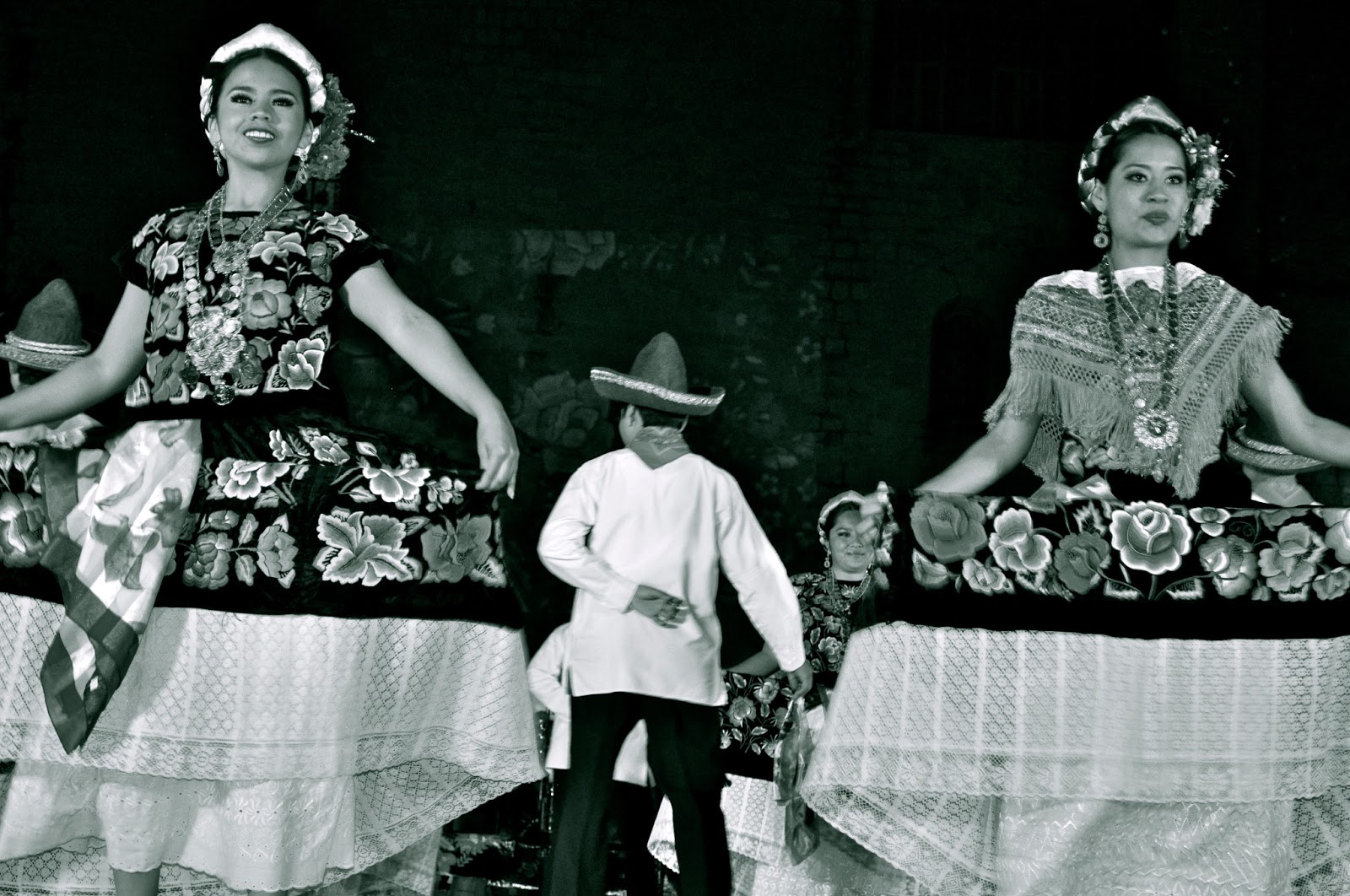
Festival de danza contemporanea
There are the constant colors parading across the zocalo, shimmering, neon colors that the children love.
Classical street musician
And the talented, colorful people who work the streets and create a cultural collage for a peso or two in their violin case or tin cup. If it happens to be Wednesday, then you have Miércoles de Danzón, the older generations version of a "rave". Men in Panama hats and dangling watch chains, and women in heels and fancy dresses sway to the beat and "dance" like you are supposed to, with rhythm and feeling. Makes a person proud to be over 50!
Miercoles de Danzón
It seems that every outing has its special surprise waiting. I like to go  to La Michoacana" ice cream shop in the evening for a delicious guanabana or mango nieve, and in doing so, often find myself sitting down to a free performance that always keeps me there until the show is over. Culture flows in the street, and the quality is outstanding. And free!!

And most importantly are all of the wonderful people that I was able to photograph and share those photos with. If you photograph people, it seems the only fair thing to do; they are so grateful for it. Thank you George Ancona for showing me how important that is. The portraits below are some of those people that are now friends. Click for a larger view, because they are all larger than life people. Adios amigos, ¡nos vemos pronto! You have taught me so much. Mil gracias!
Benita & Braulio
La Familia Perez-Nochixtlán
Domingo & Kevin Racoon
Doña Angela - Teotitlan
Doña Rosa Maria - Bread vendor

Jazmin-Weaver, Teotitlán


Doña Aurora-Arte Seda
Don Fernando - baker


Oscar & Octavio - Café Morez

Last years wrap up:
http://dick-keis.blogspot.mx/2012/04/wrapping-up-winding-down.html

Thursday, April 4, 2013

Ni Perdon, Ni Olvido


Oaxacan Artists Claudio Jeronimo and Demetrio Barrita
In May, 2006, the popular uprising in Oaxaca began. It resulted in far too many unnecessary deaths, and a hard felt blow to the economy of a city in which tourism plays an important role. Nearly seven years have passed, and this posting demonstrates that the events of 2006 are neither forgiven nor forgotten (Ni Perdon, Ni Olvido). In the six months that the uprising lasted, more than 25 protestors were killed, 70 arrested, and 40 seriously wounded. The work viewed here is a tribute to these people and the many who fearlessly partook in that struggle.This YouTube video link  is well worth watching if you would like more details of what took place in 2006. (http://www.youtube.com/watch?v=X6_HGslwUEQ)


Sculpture before going into kiln
 I was privileged to have been invited to photograph the firing of the sculpture (to right) done by Demetrio and Claudio. Demetrio is a friend of Marie's and mine, a painter, sculptor, and political activist that lives in Oaxaca. He and his wife, Estela, were very involved in the uprising in 2006. Estela, like Marie, was taken from us far too early by breast cancer. For those of you who read Spanish, the following link is a fine tribute to a fine woman: http://revolucionemosoaxaca.org/nota/realizan-homenaje-a-estela-rios-activista-de-la-appo-a-un-ano-de-su-muerte/pdf.html It also lays the foundation as to what this sculpture is all about. Claudio is a master ceramicist and good friend of un buen amigo mio, Javier, who currently lives in Oregon. The work viewed in this posting was a joint project with Demetrio that was created and fired in his studio.


Moving the pieces to the kiln
Out of the kiln and ready to be put together


The sculpture, yet unnamed, is one piece in a much larger picture. Although the piece was conceived and produced by Demetrio and Claudio, it speaks for a community that has not been silenced. It weighs approximately 180 kilos (400 lbs) and stands over nine feet tall. Work began on it in January 2013 and it was ready to be fired in mid April. Because of the size of the work, it had to be sculpted in two separate pieces in order to fit it into the kiln. The piece required 18 hours to "cook" and 18 more to cool down. It took five people to lift each of the two pieces onto the cart to move them into the kiln. Engraved on one side of the sculpture are the words: "For crimes against humanity committed by Ulises Ruiz (then governor of Oaxaca). Engraved around the middle of the sculpture are the words: "Ni Perdon, Ni Olvido (Neither forgiven nor forgotten). 

We came back thirty six hours later to see the results of the firing. Much to everyone's satisfaction, the color changes were what they had hoped for. The finished piece was exquisite! Next, it had to be taken outside and the two pieces mounted one on top of the other, quite a formidable task.
Group with finished piece
The finished piece is far more than a beautiful work; it is a political statement that is part of a popular movement. It is not destined to stand in a gallery or studio to be admired. It belongs to the people who fought, and are still fighting, the struggle in Oaxaca. Like the incredible "street graffiti" that covered the walls of Oaxaca in 2006, I believe that this sculpture will finds it public space as a tribute to those who lost their lives in the struggle, and to those who continue to fight for what they believe is right.
Oaxaca graffiti art - 2006
 PS
At the time of this posting, the teachers in Oaxaca are still in the streets and have planned a march in Mexico City in favor of their "counter-educational-reform" that the current governor of Oaxaca has accepted as a valid alternative. The federal government, however, has stated that it will not accept any counter-reforms, nor will it give in to the pressures of the protesting teachers in Oaxaca and Guerrero. More trouble ahead? Spring break is over here next Monday, and neither sides appears ready to give in. May justice and peace prevail.