Wednesday, November 5, 2014

The Grateful Dead: Part Two

El Panteón de Xoxocotlan, Oaxaca
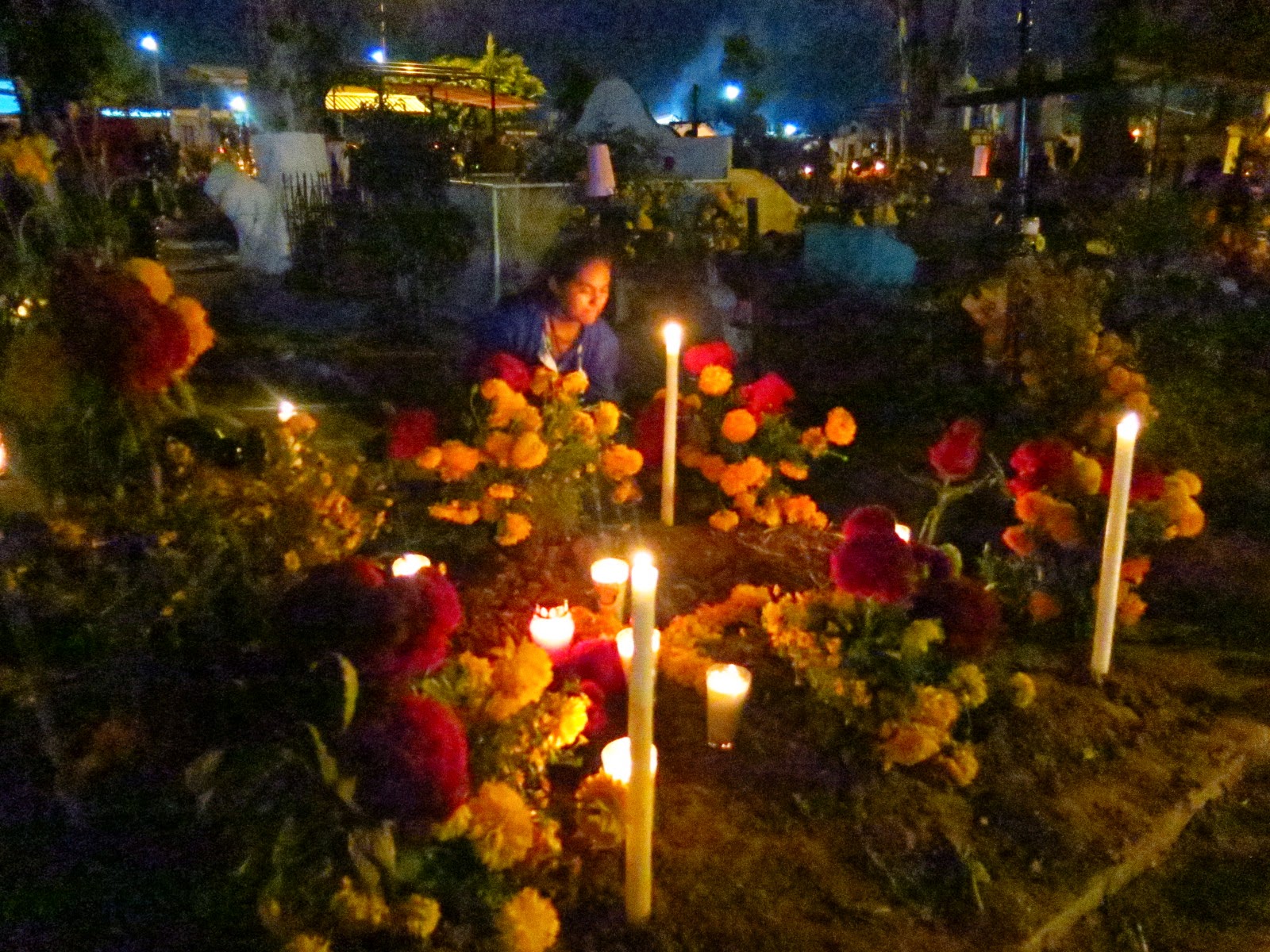
The night of October 31st was the night in Xoxocotlan to illuminate the tombs of loved ones. The cemetery was aflame with candles of all sizes, and families camped out for the night around the tombs of family members who had passed on. There were tombs of all types, some rather elaborate
and others nothing more than a mound of piled up dirt for the many who could afford nothing more. They were equally beautiful and touching. I was invited to Xoxo with the owners of my apartment, Hector and Lulú. We arrived shortly after dusk and found the cemetery already aglow and many families already installed to pass the night with their loved ones. Despite the chilly weather, there was a feeling of warmth that permeated the cemetery. Marigolds and Cockscombs were everywhere, illuminated by candles of all sizes. I felt as if I had passed through a thin veil that separated reality from otherworldliness, not sure which was which! It was truly magical.


At one end of the cemetery was an enormous stage set up for the concert by Juan Casaos, a popular Mixteca singer, and La Banda Sinfónica Juventil of his pueblo in la Mixteca, a mountainous region of Oaxaca.There were monos de calenda, giant paper maché puppets, spinning around the stage and young people performing danza folklórico to the traditional Oaxqueña music. There was no doubt that "los muertos" were having a wonderful time, going back to their tomb for a shot of mezcal and then back to the concert to join the festivities! Just goes to show that there are advantages to being dead!


Magos hererra
The evening of November first there was a special concert by Magos Hererra, a Mexican jazz vocalist now living in New York. She just happens to be one of my favorite performers! I thought I had died and gone to heaven!! Magos and her group performed outside on a very chilly Oaxaca evening to a full house. She encouraged us to applaud to keep warm, and we did.
She  herself wore a pancho given to her by Chavela Vargas, one of Mexico's most revered musical divas, who passed away in 2012. This concert was a special offering to Chavela. Magos was accompanied by a very talented group of musicians from DF (Distrito Federal). A superb performance despite the cold that kept the string players rubbing their strings to keep them tuned properly.
How was I able to get photos so close up? No security thugs guarding the stage, no check for concealed weapons at the concert site. Just a lot of good people celebrating Día de los Muertos and enjoying the incredible cultural richness of Oaxaca.


Santo Domingo
After the concert I walked to La Iglesia de Santo Domingo, a few hundred meters away. I arrived just in time for a light show projected on the facade of the church. Apparently the concert was not enough! ¡Qué chido!

My altar for Marie, minus the mezcal glass which I drank!
I went home at midnight, sensually saturated, poured myself a shot of mezcal, and one for Marie, and went to bed. I was literally "Dead tired"!


Monday, November 3, 2014

The Grateful Dead: Part One


In remembrance of the 43 students that disappeared in Guererro
Día de los Muertos has come to an end, and besides the scores of roaming spirits who have decided to stay on this side and celebrate for a while longer, things are going back to normal. What a different way of looking at death! There is normally an “alegria” in the air, and instead of sadness and melancholy dominating the scene, there is celebration and fond remembrance of loved ones passed on. This is still the case, however Día de los Muertos 2014 is also shrouded in sadness and outrage. The disappearance and probable death of forty three young students in Ayotzinapa, Guererro in late September, has placed the spotlight on deaths that never should have happened. http://www.newyorker.com/news/news-desk/crisis-mexico-forty-three-missing-students-spark-revolution
Plaza de la Danza, La Soledad
Many of the typical decorations of ofrendas and tapetes (sand paintings) have focused on this tragic event. Since September 25th, there has been no sign of the students, no bodies identified, although they have discovered mass graves, and remains are awaiting DNA testing. In the meantime, the well respected daily newspaper, La Jornada, has reported that government official have offered families of the missing students one hundred thousand pesos each for their silence. A national student strike has been called for November 5th in all parts of Mexico. Mexicans are fed up with the deaths of innocent people caused by cartels and corrupt government officials. Unrest fills the air.

But the resilient spirit of los Mexicanos shines through, despite the cloud above them. Families still make the traditional mole to share with visitors on November 2nd, the last day of the celebration. Although mole can be purchased in the market ready to use, many families still prefer to prepare it themselves, a complicated and time-consuming process.  There are four types of chiles to be toasted over a charcoal fire. There are plantains, almonds, prunes, raisins, peanuts or walnuts, cinnamon, clove, sesame seeds, onions, tomatoes, oregano, and a special bread for mole to be added ingredient by ingredient.
Doña Soledad's mole
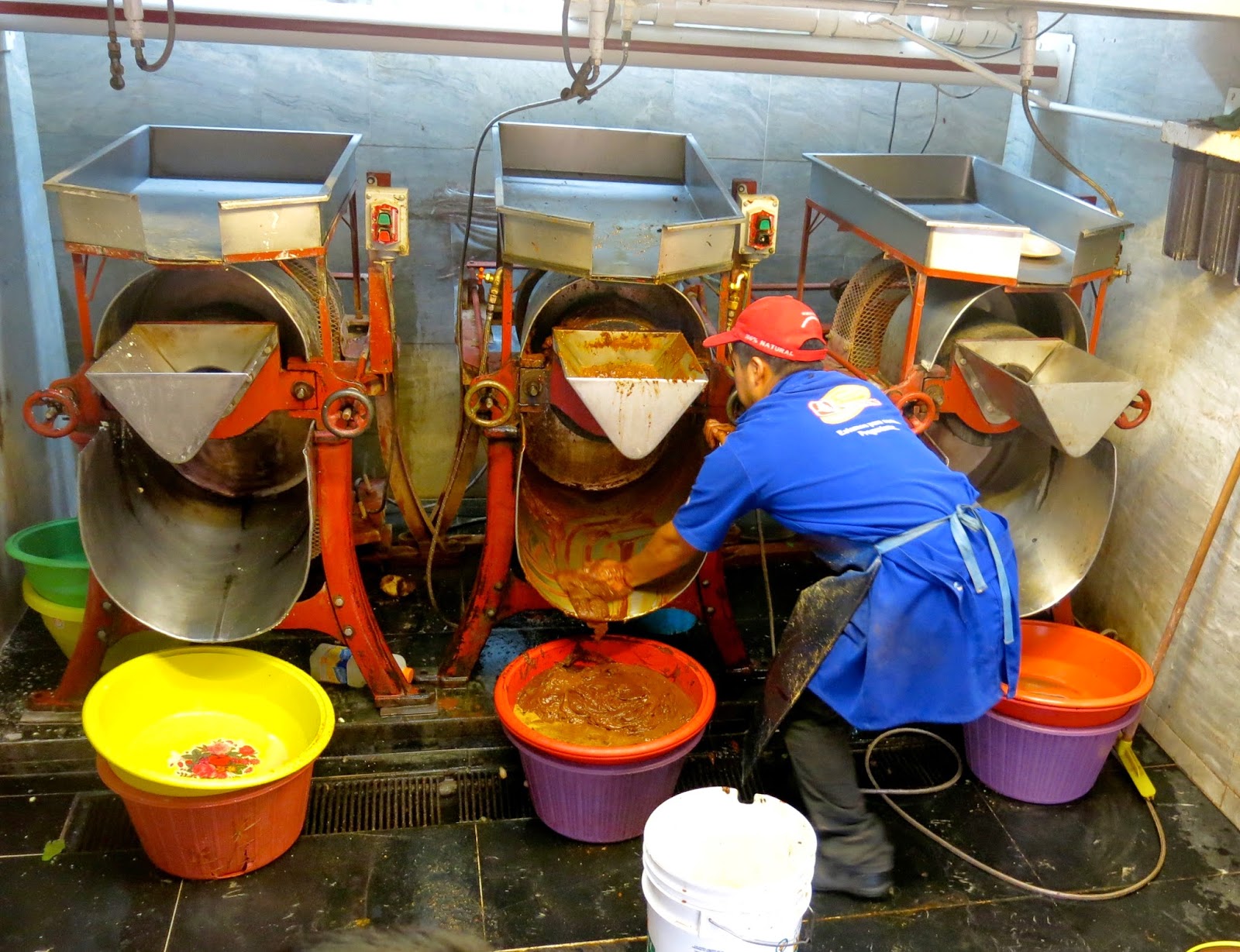
Once everything is toasted and mixed together, it is brought to the local mill to be ground. Doña Soledad took hers to the Mayordomo Chocolate mill a half kilometer away from our house.  Weaving through traffic with her hand truck was risky business, but she got there in one piece and did not lose one drop of mole!
Al molino
Then back home with the ground ingredients to cook it for a few more hours, stirring constantly, bien seguro, to avoid burning. It is a full day of preparation, morning til night.
Yesterday I had the pleasure of sharing her mole with family members and friends. It was well worth every minute of toasting, grinding, and stirring! ¡Muy, muy sabroso!

On the way to the molino to grind the mole ingredients, were stall after stall of flower vendors selling marigolds (cempasúchil), cockscomb (Terciopelo), and a variety of other flowers to adorn the altars and tombs of loved ones. There were truckloads of  flowers along the busy streets, and nearly everyone you saw had a bouquet or two in their arms. And next to the flower vendors were those selling copal, a mineral burned as incense on the ofrendas.
Copal vendor with customer
The altars and ofrendas deserve a whole blog to themselves. But since long blogs are hard to read, let it suffice here to give you a sample or two.


I always wondered where the name Grateful Dead came from; now I think I know. Who wouldn't be grateful for the abundance of all the things you liked while you were alive: food, flowers, drink, tobacco and music?


The figure below holds a banner that reads:"Death says, with me there are no bribes". Perhaps the government official who ordered the massacre of the students in Ayotzinapa should take these words into account!
Parade of Barrio de la Noria, where I live

Tuesday, September 16, 2014

A Short Reflection on the Road

 
Life, as it is called, is for most of us one long postponement. Henry Miller


As summer comes to an end, my thoughts once again turn to the road and my departure to Oaxaca. I feel very fortunate to be able to live the life I do, moving back and forth between two beautiful places. But travel is much more than just a beautiful place. As Henry Miller once wrote, "One's destination is never a place but rather a new way of looking at things". The ability to live this lifestyle is a matter of good fortune on one hand and priorities and the right choices on the other. 

I recently received an e-mail from a friend who is an accomplished photographer and children's book author. He has just submitted his 115th book for publication and is ready to start another. He wrote,"In one sense I feel very blessed and seeing life through the perspective of age. In a couple of months I'll be 85. Retire? I did that when I turned 30 and began to do what I wanted to do. And I'm still doing it"

His words struck a chord with me. Isn't that what it is all about, doing what you really want to do in life? How many of us put that off until "retirement", only to find out it is too late? 

The sketch that illustrates this post was done by Marie on one of our trips to Mexico. We met on the road and the road played an integral part of our 35 years together. When Marie passed away, I decided to continue the lifestyle that we so loved. It is certainly a different journey, but still full of wonder and newness. I wrote a poem after Marie's death to accompany her sketch:

Asi es el camino
Watch out for the train

The roads of Mexico
heading south toward the border
make me wonder where we are going,
where we belong.
Home is where the heart is, 
but hearts can stop
and one can lose their sense of place.
Así es el camino
weaving and wandering
ups and downs
but always leading somewhere.
The road map of life takes time to decipher,
many topes to cross and detours to take
before one arrives at destination unknown.

¡Buen viaje a todos!

Saturday, August 2, 2014

The Magic of Maguey


Pencas de maguey, San José del Pacifico, Oaxaca. 

The maguey is a kind of agent of history and time concentrated. It has been present as a silent witness to the all country's historic stages .... In Mexico, the culture of maguey constitutes a kind of wisdom, it has become a national emblem of the country
(Artes de Mexico, Número 51)


House in Atlanga with maguey in front
In 2006, Marie and I left to spend nine months in the small pueblo of Atlangatepec in the state of Tlaxcala. It was situated in the altiplano (high desert) region between Mexico City and Puebla, an area where maguey plants were plentiful and so were their potently popular by-products: pulque, tequila and mezcal.

One of the projects that we had in mind while in Tlaxcala was a young adult book about "el derecho de no migrar" the right to not migrate. Our storyline was a young boy who decides he does not want to go to the USA to work as all of his brothers had done. He loves his pueblo, his family, and his culture, and decides to stay in Tlaxcala and take over his father's maguey plantation and continue a life style that had been in his family for generations. So we began our research.


Fermin at work
Our friends, Paco and Alejandra, directed us to their neighbor, Don Fermin, a campesino who lived in the hills outside of Tlaxco. Fermin lived in an isolated, arid spot where little else grew except the maguey. He was alone and his children were not interested in staying on "el rancho" to care for the maguey and produce pulque, an age old fermented drink made from the sap that was extracted from the maguey. Pulque is a drink that dates back over 2000 years to the time of the Aztecs, who prized it for its healthful and aphrodisiac properties. It was still produced and consumed in Tlaxcala and Fermin had a small "pulqueria" on his land. He gladly took Marie and me around his land and showed us some of the many other uses for the maguey, from tiles for roofs to thread for making rope and baskets.

What Deek could have become!
But for Fermin, it was aguamiel (unfermented juice from the maguey used to make pulque) and his pulque that defined who he was. He took great pride in his product and as Marie sketched him, I got to sample the various stages of fermentation. As I sipped the milky substance, I wondered what would have become of me had I lived at the time when pulquerias were the gathering places for men to indulge in the vices that destroyed many of them. I decided that it was a blessing for me not to have been alive in that period of history!

We returned several times to Fermin's ranch and he was always more than willing to share his knowledge of the maguey with us. He took us out to see how the plant is "castrated" so its juice can be used for aquamiel and pulque.
Magueys, who live up to thirty five years, flower only once in their lifetime. If the quiote (flowering stalk) is cut, it will continue to produce the juice that is collected daily by the "pulquero".
Castrated maguey producing aguamiel
On one of our many ventures to "la laguna de Atlangatepec", we met José, another pulquero that befriended us. Again, we were invited to taste his creations and go with him to visit his plants and collect aguamiel. And once again, as I sampled what could have been my demise, Marie sketched José. Then she wandered off to sketch the quiote, the flower of the maguey (on the left hand side of the page) which shoots twenty five feet into the air! It seems to emerge right out of la Malinche!
José, el pulquero de Atlanga

 When we returned to Oregon in 2009, it was our intent to return to Tlaxcala the following fall and continue working on the book. That never happened. Life is like that sometimes.

As for our story, it is still fermenting in my mind. The need for something written to promote the "right not to migrate" is greater than ever as thousands of Latino children seek a safe haven in the US, a country that does not welcome them with open arms. Perhaps my next trip to Mexico will take me back to Fermin's or Jose´s magueys in search of the wisdom and inspiration that I need to move forward on the book. Much has changed since it was started six years ago. It is not just economic desperation that forces men and women to leave in search of work. It is now violence and fear that forces children to flee their families and homeland to stay alive. It seems that there are two parallel rights that need to be addressed here. The "right to not migrate" and still live a life with dignity and safety in your own country, and the "right to migrate" "al otro lado" in order to live a life free of violence and fear. Luckily I have the time to reflect on it more, and the good fortune to migrate myself, back to a country that does welcome me with open arms.And the maguey will still be there waiting to share their wisdom with me.
Maguey Fantasy
Decaying plant


Tuesday, June 24, 2014

A Dual Perspective: Doña Estela

Marie's sketch from The Art of Travel with a Sketchbook

A s many of you know, I made a promise to Marie on her death bed that I would do something with her sketchbooks. I was not sure what, but the wealth of images they contained deserved to be shared. I like to write, and the sketchbooks are incredible visual stimuli. However, that has not been so easy. I have spun my wheels for three and a half years. I have numerous starts on the book, none of them getting very far along before I "caler" (freeze up). The only success I have had, has been in my blog, where my words and Marie's images seem to blend together painlessly and naturally. There is no editor that will be looking things over with a critical eye, no judgement to be passed, no acceptance or rejection, just my writing, Marie's images, and our friends' choice to read on or not.

Last summer, My friend Dee Curwen, offered me the space at the Corvallis Multicultural Literacy Center to put together an exhibit of my photographs from Mexico. I decided to combine Marie's sketches with my photographs. It was entitled: Portraits of Mexico: A Dual Perspective. Below is an extract from my statement concerning that exhibit: The images exhibited here are my attempt to combine our ways of seeing the world around us. They are images of people who entered our lives, places that caught our eye, and the bountiful, colorful tradition that defines Mexico. They all reflect our journey through life together, our love of travel and crossing cultural borders. They are part of my journey to fulfill my promise

Doña Estela, Vendedora de Pan - 2002
 I start with the story of Doña Estela, a bread vendor in Oaxaca that Marie sketched in 2002. She had gone to the Mercado Hidalgo several times to sketch and had asked Doña Estela permission to draw her twice. Both times she refused. The image to the left is the result of her third attempt. Marie wrote on the bottom of the page, "not only did she accept, she even posed!"

In 2012 I returned to Oaxaca and decided to try to find Doña Estela. Upon arriving at Mercado Hidalgo, I found three women selling bread, but none that looked anything like Doña Estela. I had a copy of Marie's sketch with me, so I approached one of the woman, showed her the sketch, and asked her if she knew the person on the page. She replied, "Claro que si, es mi suegra" (Sure, it is my mother-in-law). She then told me the sad news that she had died the previous winter. When I told her what I was doing, she immediately offered to bring me a photo of Doña Estela. I thanked her, but told her I would rather photograph her selling bread in the same spot that her mother-in-law had. She agreed.
Doña Rosa at Mercado Hidalgo - 2012


"But if you really want a good photo, you should photograph my husband, Fernando. He makes the bread. He is a spitting image of his mother," she went on to tell me.

The next morning I went to Fernando's bakery. He was waiting for me, offered me some freshly baked pan dulce, and took me in back where his house and oven were. He went inside and came back out with a portrait of his mother. Doña Rosa was right, the same lines in the face, the same expression, even the clothes they were wearing seemed to match!
Don Fernando & Doña Estela - Panaderos

We sat and talked for a long time. Fernando told me the story of his life and his mother's. He was just getting ready to light his wood-fired oven and make bread, and asked me if I wanted to stay and watch. Of course I did.
 
Fernando was proud of his oven and his traditional way of making pan dulce. He used no chemicals or high tech equipment, just good ingredients and the skills passed down in his family. The fruits of his labor were also very pleasing to the eye, not to mention the taste buds!
Freshly baked Conchas

Right before leaving, I asked Fernando when his mother passed away. His answer gave me carne de ganso (goose bumps). She died on January 9, 2012, exactly one year to the day of Marie's passing.

Perhaps Marie and Doña Estela are now happily breaking bread together somewhere in the universe and their crumbs are falling as snow on Mount Hood. Marie may even have Doña Estela sketching! I wouldn’t be the least bit surprised!

Monday, May 19, 2014

A World of Difference

Marcelo & Concepción: los panaderos de Tanivet
I am back in Corvallis again, after a near six month stay in magical Oaxaca. It was time well spent. But, Corvallis is such an easy place to return to, especially in the spring when days are longer and sunshine more prevalent. I rediscover all the things I like about living here: good friends, beautiful surroundings, the peace and quiet of a small town, and all the cozy comforts of living "al otro lado".

Mexico is by no means a third world country. Oaxaca especially has a cosmopolitan flavor with tapa bars, organic markets, elegant rooftop bars, and fine jazz clubs. But Oaxaca, like most of Mexico, is a place of striking contrasts: modern vs ancient, rich vs poor, order vs chaos. There is an ever-present intermingling of cultures: indigenous, mestizo, and American that defines Mexico. I was fortunate to have been involved in a photography project in Tanivet, a small pueblo a half an hour outside of Oaxaca. Approximately three hundred people live in the pueblo, with another three hundred family members living in  L.A. It has a ghost town-ish feel to it: a new penitentiary with no one in it, a zoo with exotic animals that hardly anyone visits, schoolyards where children are seldom seen. Fellini would have a field day here! There are i pads and computers where there is no internet connection, large screen television monitors and fancy refrigerators in homes where no one lives, and an allegiance to the LA Lakers that would rival any home in California.

Marcelo with green card
The most memorable part of my work in this project was getting to know Marcelo and Concepcíon, the pueblo bakers. I formed an especially close relationship with Marcelo, who is the same age as I am. He was one of the first men from Tanivet to "cruzar la linea" to work in LA in the early 1970's. He still has his green card from that visit, which he believes would still get him into the States if he wanted to return. But he does not want to return, he is content baking bread to sell in Tanivet and the surrounding pueblos. He lives with the
Making conchas
memories of his youth, when it cost nothing to cross over, no coyotes, no hi-tech border surveillance equipment to intercept your passage. There is a world of difference between then and now, between Marcelo's reality and mine.


Our birthdays are only a few months apart. We passed the same number of years on this planet, but in such different ways. My life reflects the "luck of the draw", a comfortable middle class American life full of opportunities. Marcelo's life was rewarding in a different way, but definitely without the same opportunities or middle class existence that I had. One road is not better than the other, but one is much smoother with far fewer "topes" to obstruct the journey.

 From day one, Marcelo and Concepción invited me into their home and their lives without hesitation. Although they were among the poorest families in the pueblo, their generosity had no limits, what they had, they were more than willing to share. Each visit either started or ended with "taquitos a la Concepción" flavored with mesquite, their sole source of cooking fuel. It was also what fired the brick oven that is in their livingroom.

Mesquite gathered for oven
 The firewood is free, so to speak. It comes from a piece of land a kilometer or so from Marcelo's house. Thanks to money sent from the US, Marcelo has a Ford tractor and a small trailer to haul the wood. To gather the wood, it is necessary to sign a contract with the municipality of Mitla which states that in return for gathering the wood free of charge, they must cut back all the mesquite bushes to the ground and burn what remains. It is an incredible amount of work, and the mesquite is vicious! I had huge thorns go through the soles of my shoes three times in one day. As I whined about how sharp they were, they worked without gloves and smiled. Así somos los gringos!
Field burning a la Mexicana

Remembering LA
 Despite the differences in our lives, Marcelo and I became friends. We spent many hours talking as I photographed. He loved to reminisce about the time he spent "al otro lado", both the good moments and the not so pleasant ones. He has a son there now whom he has not seen for many years. He has married, has children, and has his life in LA. The separation is painful, but is accepted as "the way it has to be". It is much easier to earn a living there than it is in Tanivet. Almost every family has a loved one living and working "al otro lado", and many of the men have been there themselves. They understand the attraction, and can only hope that their children return home someday to live in the empty house that is waiting for them. But that is not a given; it is not easy to leave once you are settled and have established your life in the US. You must accept what you cannot change.

Although the project in Tanivet is finished, I have reasons to return. First, there are Marcelo and Concepción, who, despite the world of difference in our lives, are now my friends.
There is also the unique beauty that the Oaxaca countryside offers.Tanivet is in stark contrast to the colonial beauty of the city of Oaxaca. Even though it often seems desolate and abandoned, it has its own charm, so peaceful and pastoral.
The main street of Tanivet
And there are still many more hours of stories to be listened to and taquitos to share with friends (not to mention freshly baked conchas straight from the oven!)
My visits to Tanivet remind me that there is indeed a world of difference in our lives, but there are far more similarities that brings us together. There is a universal interconnectedness that crosses borders, merges cultures, and allows friendships to blossom in the most unexpected of places. 
Un abrazo de amistad, Marcelo y Concepción. Gracias por todo.
Photo by Mari Seder


I was very fortunate to have had two excellent photographers photographing Marcelo and Concepción along with me. They also have become good friends and have taught me a lot. Gracias Mari y Raquel.

Mari Seder in action


Raquel Rocha, building "confianza"